Week 02 Tutorial Questions
Recursion and Analysis of Algorithms
Recursion (25 mins)
For the programming questions below, use the following data type:
struct node {
	int value;
	struct node *next;
};
-
We say that recursion is a problem solving strategy where problems are solved via solving subproblems. What do we mean by a subproblem?
-
Suppose we want to find the length (i.e., number of nodes) of a linked list recursively.
- What is a possible subproblem for this problem?
- How does solving the subproblem help solve the original problem?
- What base case(s) exist?
Implement a recursive function that finds the length of a linked list. It should have this signature:
int listLength(struct node *l) { ... }
-
Suppose we want to count the number of odd values in a linked list recursively.
- What is a possible subproblem for this problem?
- How does solving the subproblem help solve the original problem?
- What base case(s) exist?
Implement a recursive function that counts the number of odd values in a linked list. It should have this signature:
int listCountOdds(struct node *l) { ... }
-
Suppose we want to check if a list is sorted in ascending order recursively.
- What is a possible subproblem for this problem?
- How does solving the subproblem help solve the original problem?
- What base case(s) exist?
Implement a recursive function that checks whether a list is sorted in ascending order. It should have this signature:
bool listIsSorted(struct node *l) { ... }
Analysis of Algorithms (25 mins)
-
Consider the following functions. For each one, answer the following questions:
- How long does each line take to execute?
- What is the time complexity of the overall program?
- Does the time for the program change as \(n\) increases?
Function 1
void func(int n) {
	int x = 7;
	x = x + n;
	printf("%d\n", x);
}
Function 2
void func(int n) {
	int i = 0;
	while (i < n) {
		printf("%d\n", i);
		i++;
	}
}
Function 3
void func(int n) {
	for (int i = 0; i < n; i++) {
		printf("%d\n", i);
	}
}
-
We usually express time complexity in terms of a variable \(n\). Often, we are not given \(n\) directly as an input (like in the question above), but instead the input is a data structure, such as an array. What would \(n\) represent for each of the inputs below?
- An array
- A Linked List
Extra Questions
These questions are intended to be done in your own time or at the end of the tutorial if time permits.
Recursion
-
Write a recursive function to delete the first instance of a value from a linked list, if it exists. The function should return a pointer to the beginning of the updated list. Use the following interface:
struct node *listDelete(struct node *l, int value) { ... }
-
Recall that an alternative representation of a linked list uses a struct that contains a pointer to the first node of the list:
struct list {
	struct node *head;
};
How would your recursive solutions for the above questions change if the functions took a
struct listpointer instead of a node pointer? For example:int listLength(struct list *l);
-
The Tower of Hanoi is a puzzle consisting of three rods (Rod A, B and C) and disks of various sizes. The disks are initially stacked on Rod A from largest (at the bottom) to smallest (at the top), and the goal is to move all the disks onto Rod C, while following these rules:
- Only one disk can be moved at a time
- A larger disk cannot be placed on top of a smaller disk
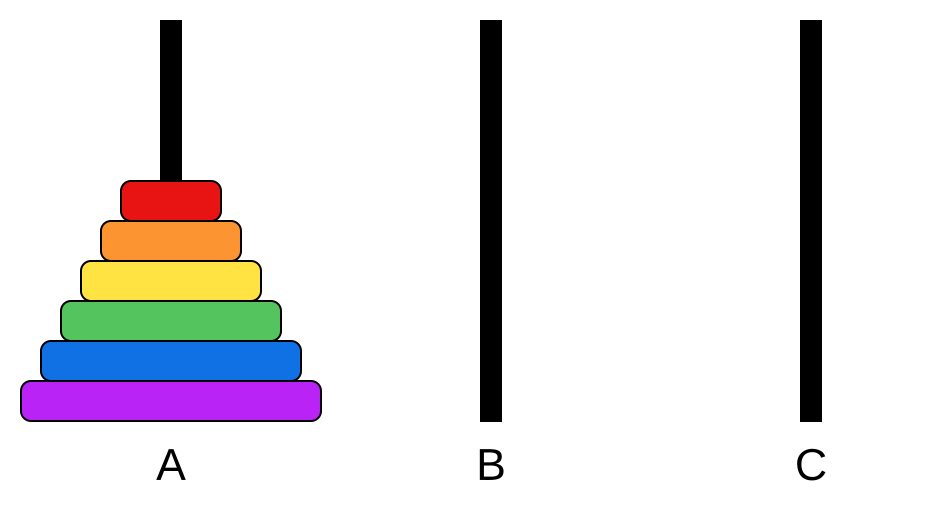
Write a function that prints out instructions to complete the puzzle. The function should take in the number of disks, and the names of the three rods (A, B and C).
void solveHanoi(int numDisks, char *fromRod, char *toRod, char *otherRod) { ... }
For example, for three disks, the function call
solveHanoi(3, "A", "C", "B")should print the following:Move disk from Rod A to Rod C Move disk from Rod A to Rod B Move disk from Rod C to Rod B Move disk from Rod A to Rod C Move disk from Rod B to Rod A Move disk from Rod B to Rod C Move disk from Rod A to Rod C
Analysis of Algorithms
-
Design an algorithm to determine if a string of length \( n \) is a palindrome - that is, it reads the same backwards as forwards. For example, "racecar" is a palindrome, while "reviewer" is not.
- Write the algorithm in pseudocode.
- Analyse the worst-case time complexity of your algorithm.
-
Implement your algorithm in C. Your program should accept a single command line argument, and check whether it is a palindrome. Examples of the program executing are:
./palindrome racecar
yes
./palindrome reviewer
no
Hint: You may use the standard library function strlen(3), which has prototypesize_t strlen(char *), is defined in<string.h>, and which computes the length of a string (without counting its terminating'\0'character).
-
Using only techniques that you have learned so far, design an algorithm to determine if an array contains two elements that sum to a given value.
- Write the algorithm in pseudocode.
- Analyse the worst-case time complexity of your algorithm.
- Implement your algorithm as a function in C. The algorithm should accept an array and a value as input and return true or false.