Week 02 Tutorial Answers
Recursion and Analysis of Algorithms
Recursion (25 mins)
For the programming questions below, use the following data type:
struct node {
	int value;
	struct node *next;
};
-
We say that recursion is a problem solving strategy where problems are solved via solving subproblems. What do we mean by a subproblem?
Answer:
A subproblem is a smaller instance of the same problem.
For example, we can calculate \(n!\) (\(n\) factorial) by noticing that \(n! = n \times (n - 1)!\) for \(n > 0\). In this case, the subproblem is \((n - 1)!\), which is a smaller instance of the same problem.
-
Suppose we want to find the length (i.e., number of nodes) of a linked list recursively.
- What is a possible subproblem for this problem?
- How does solving the subproblem help solve the original problem?
- What base case(s) exist?
Implement a recursive function that finds the length of a linked list. It should have this signature:
int listLength(struct node *l) { ... }
Answer:
- A possible (and suitable) subproblem is finding the length of the rest of the list (i.e., the same list but without the first node).
- If we know the length of the rest of the list, then the length of the original list is just one greater!
- If the list is empty, then the length is 0.
Recursive function that finds the length of a linked list:
int listLength(struct node *l) {
	if (l == NULL) {
		return 0;
	} else {
		return 1 + listLength(l->next);
	}
}
-
Suppose we want to count the number of odd values in a linked list recursively.
- What is a possible subproblem for this problem?
- How does solving the subproblem help solve the original problem?
- What base case(s) exist?
Implement a recursive function that counts the number of odd values in a linked list. It should have this signature:
int listCountOdds(struct node *l) { ... }
Answer:
- A possible (and suitable) subproblem is counting the number of odd values in the rest of the list.
- If we know the number of odd values in the rest of the list, then:
- If the first value is even, then the number of odd values in the original list is the same
- If the first value is odd, then the number of odd values in the original list is just one greater!
- If the list is empty, then the number of odd values is 0.
Recursive function that counts the number of odd values in a linked list:
int listCountOdds(struct node *l) {
	if (l == NULL) {
		return 0;
	}

	int numOddsInRestOfList = listCountOdds(l->next);
	if (l->value % 2 != 0) {
		return 1 + numOddsInRestOfList;
	} else {
		return numOddsInRestOfList;
	}
}
-
Suppose we want to check if a list is sorted in ascending order recursively.
- What is a possible subproblem for this problem?
- How does solving the subproblem help solve the original problem?
- What base case(s) exist?
Implement a recursive function that checks whether a list is sorted in ascending order. It should have this signature:
bool listIsSorted(struct node *l) { ... }
Answer:
- A possible (and suitable) subproblem is checking if the rest of the list is sorted.
- If we know whether the rest of the list is sorted, then:
- If the rest of the list is not sorted, then the original list is also not sorted!
- If the rest of the list is sorted, then whether the original list is sorted just depends on whether the first two values are in the right order!
- We have at least two base cases:
- If the list is empty, then it is sorted
- If the list has only one value, then it is sorted
Recursive function that checks if a list is sorted:
bool listIsSorted(struct node *l) {
	// an empty list is sorted
	if (l == NULL) {
		return true;
	}

	// a list with one value is sorted
	if (l->next == NULL) {
		return true;
	}

	bool isRestOfListSorted = listIsSorted(l->next);

	// if the rest of the list is not sorted, then the list is not sorted
	if (isRestOfListSorted == false) {
		return false;
	}

	return l->value <= l->next->value;
}
Note that we could check if the first two values are out of order before recursing, and return false if so, which would be more efficient when the list is not sorted. If the list is sorted, we always need to recurse through the entire list.
Analysis of Algorithms (25 mins)
-
Consider the following functions. For each one, answer the following questions:
- How long does each line take to execute?
- What is the time complexity of the overall program?
- Does the time for the program change as \(n\) increases?
Function 1
void func(int n) {
	int x = 7;
	x = x + n;
	printf("%d\n", x);
}
Function 2
void func(int n) {
	int i = 0;
	while (i < n) {
		printf("%d\n", i);
		i++;
	}
}
Function 3
void func(int n) {
	for (int i = 0; i < n; i++) {
		printf("%d\n", i);
	}
}
Answer:
No answers are available for this question. -
We usually express time complexity in terms of a variable \(n\). Often, we are not given \(n\) directly as an input (like in the question above), but instead the input is a data structure, such as an array. What would \(n\) represent for each of the inputs below?
- An array
- A Linked List
Answer:
- \(n\) is the size of the array, i.e., the number of values in the array
- \(n\) is the length of the linked list, i.e., the number of nodes in the list
Note that time complexity can sometimes be expressed in terms of multiple variables (e.g., \(n\) and \(m\)), especially if there are multiple inputs.
Extra Questions
These questions are intended to be done in your own time or at the end of the tutorial if time permits.
Recursion
-
Write a recursive function to delete the first instance of a value from a linked list, if it exists. The function should return a pointer to the beginning of the updated list. Use the following interface:
struct node *listDelete(struct node *l, int value) { ... }
Answer:
struct node *listDelete(struct node *l, int value) {
	if (l == NULL) {
		return NULL;
	} else if (l->value == value) {
		struct node *restOfList = l->next;
		free(l);
		return restOfList;
	} else {
		l->next = listDelete(l->next, value);
		return l;
	}
}
-
Recall that an alternative representation of a linked list uses a struct that contains a pointer to the first node of the list:
struct list {
	struct node *head;
};
How would your recursive solutions for the above questions change if the functions took a
struct listpointer instead of a node pointer? For example:int listLength(struct list *l);
Answer:
We can't recurse through the list with a
struct listpointer, because the nodes themselves are represented by a different struct type (struct node). Therefore, we need to create a helper function to perform the recursion, that takes in astruct nodepointer. We can then call the helper function from the original function.listLength,listCountOddsandlistIsSortedwould be implemented as follows:int listLength(struct list *l) { return listLengthRec(l->head); } int listCountOdds(struct list *l) { return listCountOddsRec(l->head); } bool listIsSorted(struct list *l) { return listIsSortedRec(l->head); }
where
listLengthRec,listCountOddsRecandlistIsSortedRecare the recursive solutions to questions 1-3 above.A function that takes a
struct listpointer does not need to return a pointer to the beginning of the list if it modifies the list. Thus,listDeletecan be avoidfunction. It would be implemented as follows:void listDelete(struct list *l, int value) { l->head = listDeleteRec(l->head, value); }
where
listDeleteRecis the solution to question 4 above. Note that the return value of the recursive functions must be assigned back tol->head, because if the first node of the list changes,l->headmust be updated to point to the new first node. -
The Tower of Hanoi is a puzzle consisting of three rods (Rod A, B and C) and disks of various sizes. The disks are initially stacked on Rod A from largest (at the bottom) to smallest (at the top), and the goal is to move all the disks onto Rod C, while following these rules:
- Only one disk can be moved at a time
- A larger disk cannot be placed on top of a smaller disk
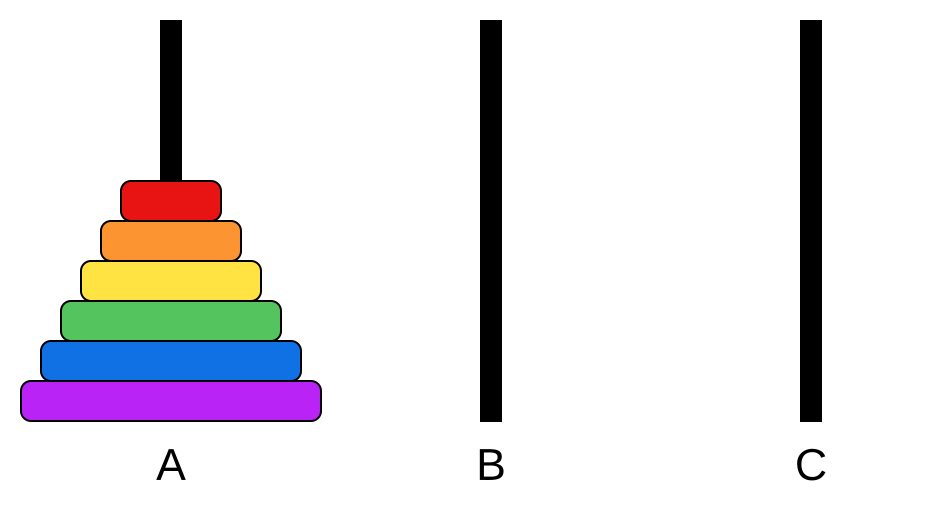
Write a function that prints out instructions to complete the puzzle. The function should take in the number of disks, and the names of the three rods (A, B and C).
void solveHanoi(int numDisks, char *fromRod, char *toRod, char *otherRod) { ... }
For example, for three disks, the function call
solveHanoi(3, "A", "C", "B")should print the following:Move disk from Rod A to Rod C Move disk from Rod A to Rod B Move disk from Rod C to Rod B Move disk from Rod A to Rod C Move disk from Rod B to Rod A Move disk from Rod B to Rod C Move disk from Rod A to Rod C
Answer:
Behold, the power of recursion!
void solveHanoi(int numDisks, char *fromRod, char *toRod, char *otherRod) {
	if (numDisks == 0) return;

	solveHanoi(numDisks - 1, fromRod, otherRod, toRod);
	printf("Move disk from Rod %s to Rod %s\n", fromRod, toRod);
	solveHanoi(numDisks - 1, otherRod, toRod, fromRod);
}
Analysis of Algorithms
-
Design an algorithm to determine if a string of length \( n \) is a palindrome - that is, it reads the same backwards as forwards. For example, "racecar" is a palindrome, while "reviewer" is not.
- Write the algorithm in pseudocode.
- Analyse the worst-case time complexity of your algorithm.
-
Implement your algorithm in C. Your program should accept a single command line argument, and check whether it is a palindrome. Examples of the program executing are:
./palindrome racecar
yes
./palindrome reviewer
no
Hint: You may use the standard library function strlen(3), which has prototypesize_t strlen(char *), is defined in<string.h>, and which computes the length of a string (without counting its terminating'\0'character).
Answer:
-
isPalindrome(S):
	Input:  array S[0..n - 1] of characters
	Output: true if S is a palindrome, false otherwise

	l = 0
	r = n - 1
	while l < r do
		if S[l] ≠ S[r] then
			return false
		end if
		l = l + 1
		r = r - 1
	end while

	return true
-
The worst case occurs when the string is a palindrome, as the while loop must run to completion. In this case, the number of times each line is executed is:
isPalindrome(S):
	Input:  array S[0..n - 1] of characters
	Output: true if S is a palindrome, false otherwise

	l = 0                                   <-- 1
	r = n - 1                               <-- 1
	while l < r do                          <-- n/2
		if S[l] ≠ S[r] then                 <-- n/2
			return false
		end if
		l = l + 1                           <-- n/2
		r = r - 1                           <-- n/2
	end while

	return true                             <-- 1
This is \(2n + 3\) line executions, so the worst-case time complexity is \(O(n)\).
In fact, there is no need to count line executions. By observing that there are at most \( \lfloor n/2 \rfloor \) iterations of the loop and the operations inside the loop are \( O(1) \), we can conclude that the worst-case time complexity is \( O(n) \).
-
#include <stdbool.h>
#include <stdio.h>
#include <string.h>

static bool isPalindrome(char *s);

int main(int argc, char *argv[]) {
	if (argc == 2) {
		if (isPalindrome(argv[1])) {
			printf("yes\n");
		} else {
			printf("no\n");
		}
	}
	return 0;
}

static bool isPalindrome(char *s) {
	int l = 0;
	int r = strlen(s) - 1;

	while (l < r) {
		if (s[l] != s[r]) {
			return false;
		}
		l++;
		r--;
	}
	return true;
}
-
Using only techniques that you have learned so far, design an algorithm to determine if an array contains two elements that sum to a given value.
- Write the algorithm in pseudocode.
- Analyse the worst-case time complexity of your algorithm.
- Implement your algorithm as a function in C. The algorithm should accept an array and a value as input and return true or false.
Answer:
-
hasTwoSum(A, v):
	Input:  array A[0..n - 1] of integers
	        integer v
	Output: true if A contains two elements that sum to v, false otherwise

	for i = 0 up to n - 1 do
		for j = i + 1 up to n - 1 do
			if A[i] + A[j] = v then
				return true
			end if
		end for
	end for

	return false
- The worst case occurs when there are no two elements that sum to the given value. In this case, there are \( n \) iterations of the outer loop and \( (n - 1) + (n - 2) + \ldots + 1 + 0 = \frac{1}{2} n(n - 1) \) iterations of the inner loop. Removing constant factors and lower terms gives a worst case time complexity of \( O(n^2) \).
-
bool hasTwoSum(int a[], int n, int v) {
	for (int i = 0; i < n; i++) {
		for (int j = i + 1; j < n; j++) {
			if (a[i] + a[j] == v) {
				return true;
			}
		}
	}
	return false;
}