Week 04 Tutorial Notes
ADTs, Binary Search Trees
Group Question
- Starting from an intially empty tree:
- Insert the values into the tree in this order: [10 11 6 4 5 8 7 9 1]
- What is the height of the resulting tree?
- What is the post-order traversal of this tree?
- Draw a trace around the tree, similar to what your tutor demonstrated.
- What is a Post-Order traversal useful for?
- In-Order: Prints the values in ascending order.
- Pre-order: Copies the shape of the tree.
- Write down the pseudocode implementation for Post-Order.
- Hint: It is 4-5 lines of C code.
- What line needs to change in your implementation to make it print an In-Order traversal instead?
- Hint: Only 1 line needs modified and shifted within the function.
-
Your task is to draw the solution for this problem:
int bstSumEvens(struct node *t);
Redraw the diagram to answer the following questions:
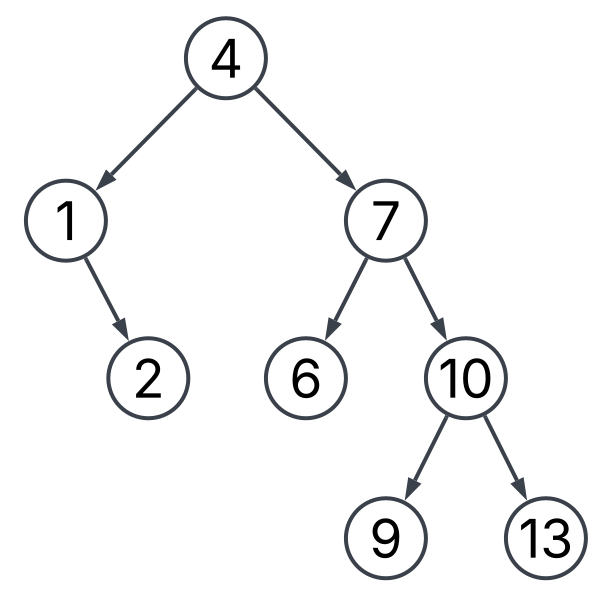
- What should the function return when given the whole tree?
- What is the base case?
- Circle one case on your diagram.
- Give the answer for this base case.
- Starting at node 4:
- Draw a Triangle around the Left subtree and lable
L. - Draw a Triangle around the Right subtree and lable
R. - What would the function return when it recurses on
L? - What would the function return when it recurses on
R? - How do we combine the recursive steps for a full solution?
- Write out the pseudocode implementation.
-
Your task is to draw the solution for this problem:
int bstHeight(struct node *t);
Redraw the diagram to answer the following questions:
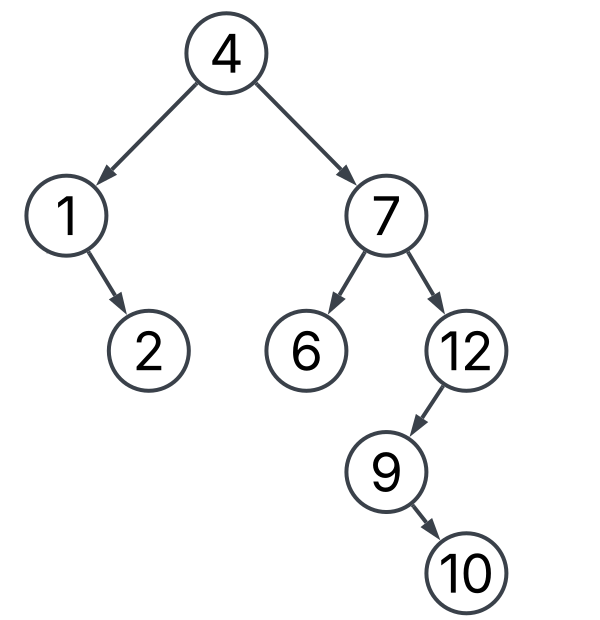
- What should the function return when given the whole tree?
- What is the base case?
- Circle one case on your diagram.
- Give the answer for this base case.
- Starting at node 4:
- Draw a Triangle around the Left subtree and lable
L. - Draw a Triangle around the Right subtree and lable
R. - What would the function return when it recurses on
L? - What would the function return when it recurses on
R? - How do we combine the recursive steps for a full solution?
- Write out the pseudocode implementation.
- Look at part c.
- The height of the tree is 3.
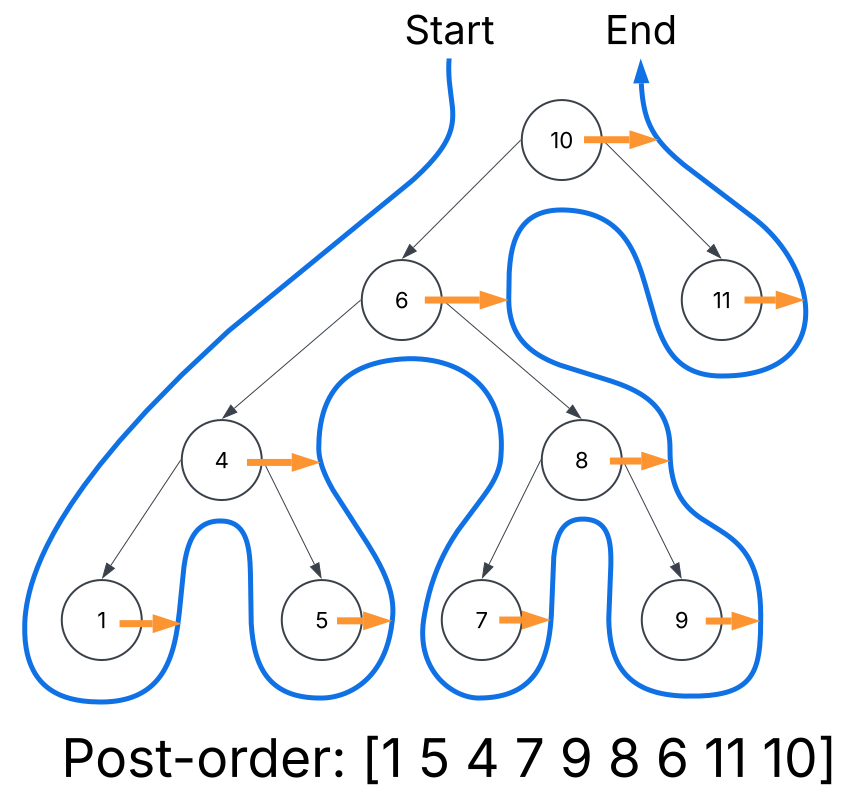
- Post-Order is useful for deleting the tree because it starts at the bottom most values first, and works it's way up the tree.
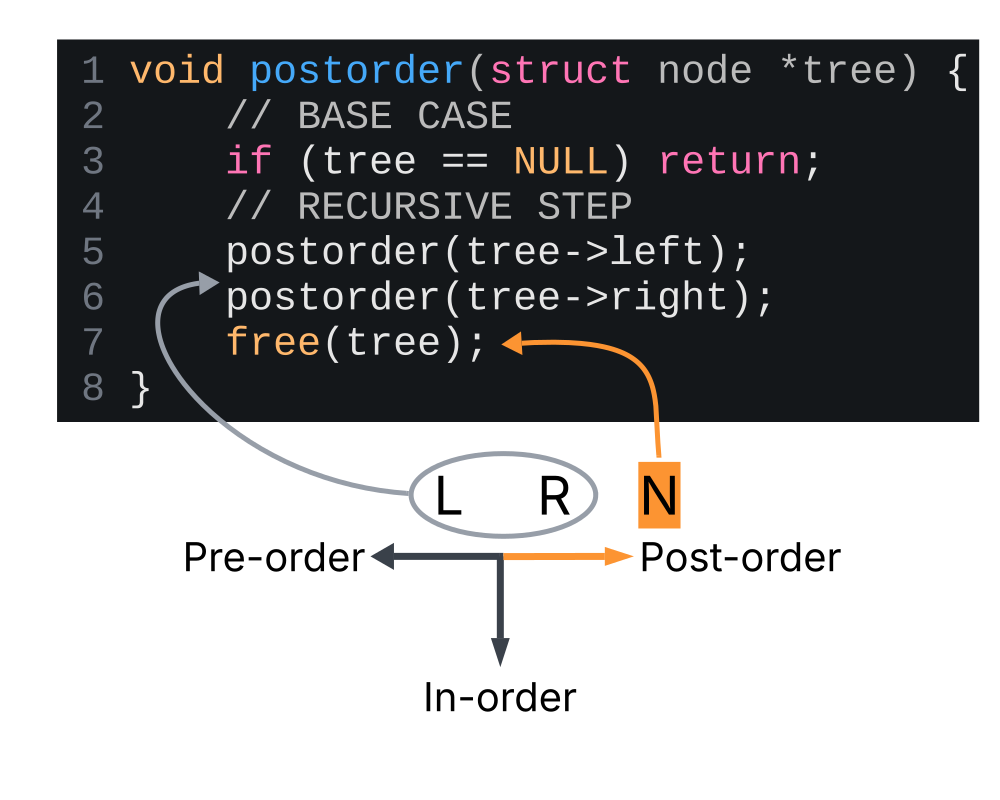
- To change the above code into an In-Order Traversal change
free(tree) to - bstSumEvens() = 22 for the full tree.
- Base Case is when the node is NULL. The answer to
bstSumEvens()at this case is 0. 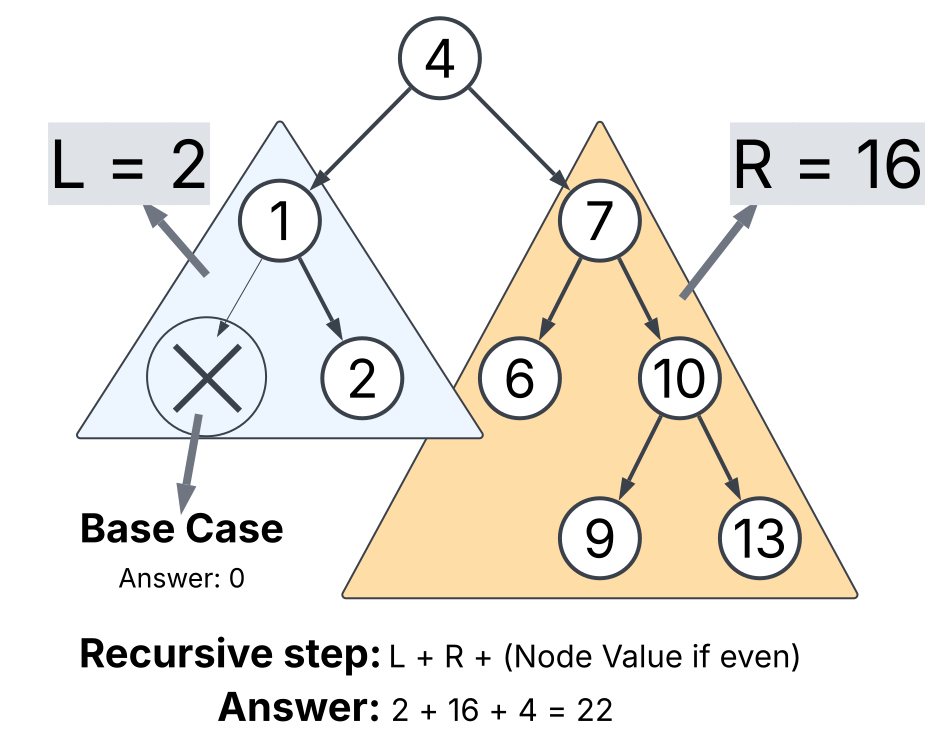
- L + R + (the value of the node if it is even).
-
int bstSumEvens(struct node *t) {
    // BASE CASE: When tree is null return 0
    // L = bstSumEvens(tree->right);
    // R = bstSumEvens(tree->right);
    // if (t is odd) return L + R
    // else return L + R + t->value
}
- bstHeight() = 4 for the full tree.
- Base Case is when the node is NULL.
The answer to
bstHeight()at this case is -1. Because a single node has height 0. We need a way to tell these two different cases apart.Also for a tree containing only one node, both left and right children are NULL, which gives height = max(-1,-1) + 1 = 0.
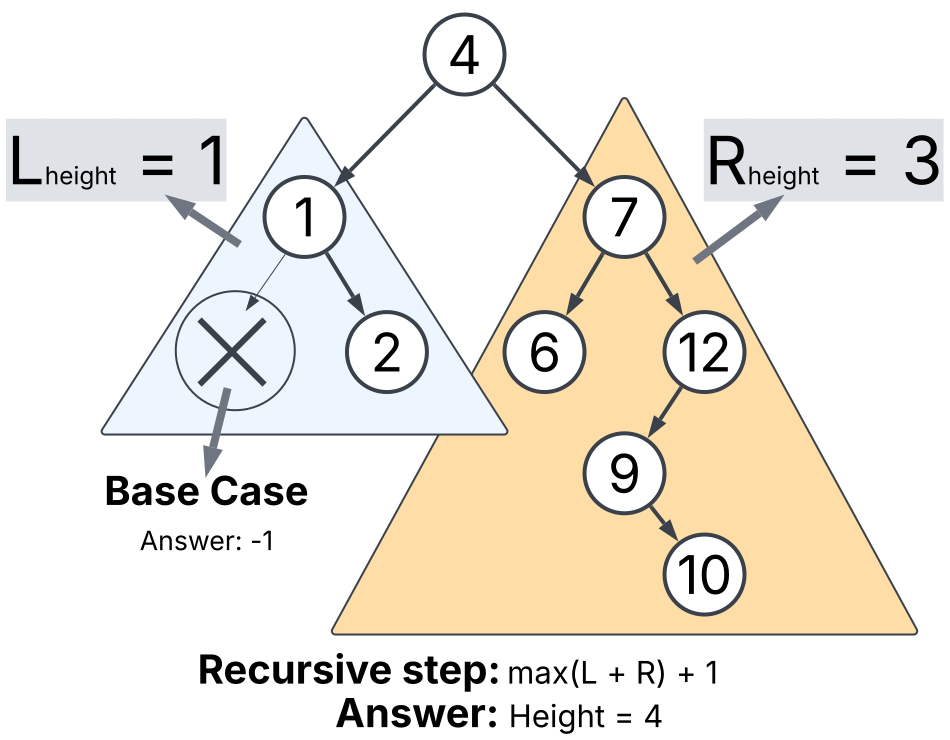
- Max(L + R) + 1.
-
int bstHeight(struct node *t) {
    // BASE CASE
    if (t == NULL) return -1;
    // RECURSIVE STEP
    int lheight = bstHeight(t->left);
    int rheight = bstHeight(t->right);
    int max = (lheight > rheight) ? lheight : rheight;
    return max + 1;
}
-
Given the head of a linked list can you find the midpoint by only using recursion?
struct node findMid(struct node *curr);
Examples:
- [1 2 3 4 5 6] - midpoint is 4.
- [1 2 3 4 5] - midpoint is 3.
Group Work Answers:
Click each section to reveal.
printf(tree->value); and place it between the left and right recursive calls.