Note that some things that might be regarded as incorrect from the samples below, would be treated as correct if there is an accompanying assumption or justification.
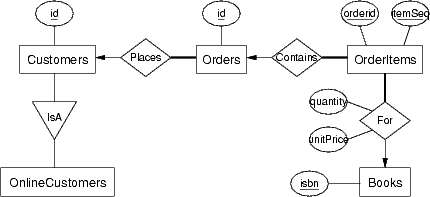
Version 1: with OrderItems as a full entity
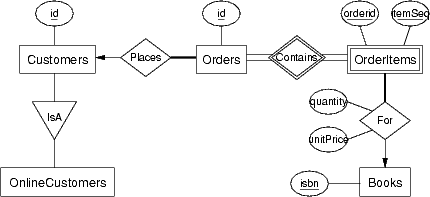
Version 2: with OrderItems as a weak entity
Version 3: with OrderItems as a relationship

In the examples where OrderItems are an entity, the attributes for quantity and unitPrice could equally-well be attributes of OrderItems or of the relationship between OrderItems and Books.
Use any of the recognised notations for indicating cardinality and participation constraints is allowed, not just the notation above.
Books:
isbn -> title,authors,publisher,yearPublished,price,qtyInStock

Customers:
id -> name,address,phone

OnLineCustomers:
id -> username,password,email

Orders:
id -> customer,datePlaced,discount,dateShipped,datePaid

OrderItems:
orderid,itemSeq -> bookisbn,quantity,unitPrice
Prooof of 3NF:
If the above "obvious" FDs are the ones given, then the proof of 3NF has to say something like ...
In each table, all non-key attributes in each relation are functionally dependent on the entire key => each table is in 3NF => the schema is 3NF
This solution is awarded an A grade.
If some steps are omitted (e.g. don't say "for each table", or don't say "each table is 3NF, etc.), then B grade.
For lower grades, based on how much of the above solution was given.
It's ok (but slightly irrelevant) to mention that there is enough "linkage" between the tables so that the data can be put together again. (If we'd started from a single "super-table" and done a decomposition, this comment would make more sense).
More complex answers might consider additional *possible* FDs. If they do, each FD has to be supported by an assumption, e.g.
OnLineCustomers:
id -> username,password,email

[ email -> username ] must also have assumption only one account per user
[ username -> email ] must also have assumption only one account per user
If these FDs are included, then ought to conclude that the schema is *not* in 3NF, using the argument:
Some tables (e.g. OnLineCustomers) have non-key attributes that are functionally dependent on other non-key attributes => this table (and thus the whole schema) is not in 3NF (in fact, not even 2NF)
A complete argument like this, is awarded an A grade.
Lower grades are awarded if omitted assumptions to justify other FDs or skipped some of the "obvious" FDs or skipped parts of the proof.
- How many different books does the bookstore have in stock?
select count(distinct title||authors)
from   Books
where  qtyInStock > 0;
- Which books have multiple editions in stock?
select title,authors
from   Books
group  by title,authors
having count(distinct yearPublished) > 1;
- Email addresses of customers with unpaid but shipped orders
select distinct c.email
from   OnLineCustomers c, Orders o
where  c.id=o.customer and o.dateShipped is not null and o.datePaid is null;
- How many orders have been placed by each on-line customer (incl zero)?
-- using PostgreSQL syntax
select c.id,c.username,count(o.id)
from   OnLineCustomers c left outer join Orders o on (c.id=o.customer)
group  by c.id,c.username;

-- using Oracle 8 syntax
select c.id,c.username,count(o.id)
from   OnLineCustomers c, Orders o
where  c.id = o.customer(+)
group  by c.id,c.username;
- Price increase of 10% on all books whose value is less than $100
update Books
set    price = price * 1.10
where  price < 100.00;
- Can an order be met from book stocks in warehouse?
create or replace function shippable(ordid integer) return varchar is n integer; ok varchar(10); begin select id into n from Orders where id=ordid; ok := 'true'; n := 0; for it in (select b.isbn,i.quantity,b.qtyInStock from OrderItems i, Books b where i.orderid=ordid and i.bookisbn=b.isbn) loop n := n + 1; if (it.quantity > it.qtyInStock) then ok := 'false'; end if; end loop; return ok; exception when no_data_found then dbms_output.put_line('No such order: '||ordid); return 'false'; end; / -- OR create or replace function shippable(ordid integer) return varchar is n integer; begin select id into n from Orders where id=ordid; select count(isbn) into n from OrderItems i, Books b where i.orderid=ordid and i.bookisbn=b.isbn and i.quantity > b.qtyInStock; return (n = 0); exception when no_data_found then dbms_output.put_line('No such order: '||ordid); return 'false'; end; / - Total value of books on an order
create or replace function orderAmount(ordid integer) return real is val real; tot real; discnt real; begin select id into n from Orders where id=ordid; select discount into discnt from Orders where id=ordid; tot := 0.00; for it in (select quantity,unitprice from OrderItems where orderid=ordid) loop val := it.quantity * it.unitprice; tot := tot + val; end loop; tot := tot * (1.0 - discnt); return tot; exception when no_data_found then dbms_output.put_line('No such order: '||ordid); return null; end; / -- OR create or replace function orderAmount(ordid integer) return real is tot real; begin select id into n from Orders where id=ordid; select sum(i.quantity*i.unitprice*(1.0-discount)) into tot from OrderItems i, Orders o where i.orderid=ordid and o.id=i.orderid; return tot; exception when no_data_found then dbms_output.put_line('No such order: '||ordid); return null; end; / - Trigger to set discount in new orders
create trigger orderInsertTrigger
before insert on Orders
for each row
declare
	nords  integer;
	discnt real;
begin
	select count(*) into nords
	from   Orders o
	where  o.customer = :new.customer
	       and orderAmount(o.id) > 100
	       and (sysdate()-o.datePlaced) < 90;
	discnt := nords * 0.05;
	if (discnt > 0.3) then discnt := 0.3; end if;
	:new.discount := discnt;
end;
/
- select * from Orders where id = 7654321;
create index SomeName on Orders (id); - select * from Orders where customer = 123456;
create index SomeName on Orders (customer); - select authors from Books where title like '%Database%';
No index can help with "like" queries - select title from Books where price between 50.00 and 100.00;
create index SomeName on Books (price); - select name,datePlaced from Orders,Customers where Orders.customer = Customer.id;
existing index on Customers is ok
create index on Orders (customer);
- Which grant fails? Why does it fail?
Failed operation ... C: grant select on Orders to D;
Why it fails ... because C didn't get the [select] privilege with grant option. - Which privileges apply after all grants?
select insert delete update A v v v v B v v v v C v v v v D X X X v E v v v X - Which privileges apply after all revokes?
        select  insert  delete  update
A       v       v       v       v
B       v       v       v       v
C       X       v       v       X
D       X       X       X       X
E       v       v       v       X