Week 4: Graph Data Structures
COMP9024 26T1 ♢ Graph Data Structures ♢ [0/110]
Things to Note …
- Large Assignment - Aiming to release by start of Week 5
⇒ Graphs will play a role …
In This Lecture …
- Graph data structures
(Slides, [S] Ch. 17.1-17.5)
- Graph traversal
(Slides, [S] Ch. 17.7, 18.1-18.3, 18.7)
Coming Up …
- Algorithms on graphs
([S] Ch. 19-22)
COMP9024 26T1 ♢ Graph Data Structures ♢ [1/110]
The next in a series on famous computer scientists …

What he invented affects your life every single day …
COMP9024 26T1 ♢ Graph Data Structures ♢ [2/110]
❖ Nerds You Should Know (cont) | |
|
Sir Tim Berners-Lee

|
|
- Oxford CS Graduate (1976)
- Software engineer at CERN
- Founder/Director of W3C at MIT (1994)
- Inventing the Web …
- distributed hypertext
- linking heterogeneous documents
- universal naming scheme (URL)
- transfer protocol (http)
- later apologised for initial pair of slashes ('
//') in a web address
- also thinks he should have defined web addresses the other way round (
au.edu.unsw.cse)
- Winner of the Turing Award in 2016
|
COMP9024 26T1 ♢ Graph Data Structures ♢ [3/110]
❖ Nerds You Should Know (cont) | |
Tim Berners-Lee's original diagram of the "Web"
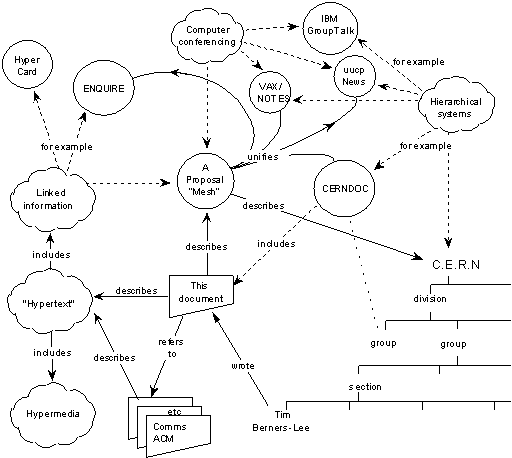 (from his proposal document, 1989)
web of notes with links between them.
From that idea came the basic components still used today:
- URL - addressing documents
- HTTP - protocol for retrieving them
- HTML - format for documents
- Web browser + server
The diagram was the conceptual model for the entire web.
COMP9024 26T1 ♢ Graph Data Structures ♢ [4/110]
COMP9024 26T1 ♢ Graph Data Structures ♢ [5/110]
Many applications require
- a collection of items (i.e. a set)
- relationships/connections between items
Examples:
- maps: items are cities, connections are roads
- web: items are pages, connections are hyperlinks
Collection types you're familiar with
- arrays, lists … linear sequence of items
Graphs are more general … allow arbitrary connections
COMP9024 26T1 ♢ Graph Data Structures ♢ [6/110]
A graph G = (V,E)
- V is a set of vertices
- E is a set of edges (subset of V×V)
Example:
COMP9024 26T1 ♢ Graph Data Structures ♢ [7/110]
A real example: Australian road distances
| Distance |
Adelaide |
Brisbane |
Canberra |
Darwin |
Melbourne |
Perth |
Sydney |
| Adelaide |
- | 2055 | - | 3051 | 732 | 2716 | - |
| Brisbane |
2055 | - | - | 3429 | 1671 | - | 982 |
| Canberra |
- | - | - | - | 658 | - | 309 |
| Darwin |
3051 | 3429 | - | - | - | 4049 | - |
| Melbourne |
732 | 1671 | 658 | - | - | - | 873 |
| Perth |
2716 | - | - | 4049 | - | - | - |
| Sydney |
- | 982 | 309 | - | 873 | - | - |
Notes: vertices are cities, edges are distance between cities, symmetric
COMP9024 26T1 ♢ Graph Data Structures ♢ [8/110]
Alternative representation of above:
The table is good for storing data systematically.
The graph diagram is good for seeing structure quickly:
- which cities are directly connected
- which cities have many connections
- possible paths between cities
COMP9024 26T1 ♢ Graph Data Structures ♢ [9/110]
Questions we might ask about a graph:
- is there a way to get from item A to item B?
- what is the best way to get from A to B?
- which items are connected?
Graph algorithms are generally more complex than tree/list ones:
- no implicit order of items (cf. linked lists)
- graphs may contain cycles
- concrete representation (i.e., a data structure) is less obvious
- algorithm complexity depends on connection complexity
COMP9024 26T1 ♢ Graph Data Structures ♢ [10/110]
For now, consider a graph with no (a,a) and no direction, no weight
Terminology:
|V| and
|E| (cardinality) normally written just as
V and
E.
A graph with V vertices has at most V(V-1)/2 edges.
- each V could connect to V-1 others
- a,b is the same as b,a
The ratio E:V can vary considerably.
- if E is closer to V2, the graph is dense
- if E is closer to V, the graph is sparse
- Example: web pages and hyperlinks
Knowing whether a graph is sparse or dense is important
- may affect choice of data structures to represent graph
- may affect choice of algorithms to process graph
COMP9024 26T1 ♢ Graph Data Structures ♢ [11/110]
❖ Exercise: Number of Edges | |
The edges in a graph represent pairs of connected vertices.
A graph with V vertices has V2 such pairs.
Consider V = {1,2,3,4,5} with all possible pairs:
E = { (1,1), (1,2), (1,3), (1,4), (1,5), (2,1), (2,2), …, (4,5), (5,5) }
Why do we say that the maximum #edges is V(V-1)/2?
COMP9024 26T1 ♢ Graph Data Structures ♢ [12/110]
… because
- (v,w) and (w,v) denote the same edge (in an undirected graph)
- we do not consider loops (v,v) (in undirected graphs)
COMP9024 26T1 ♢ Graph Data Structures ♢ [13/110]
For an edge e that connects vertices v and w
- v and w are adjacent (neighbours)
- e is incident on both v and w
Degree of a vertex
v
- number of edges incident on v
Synonyms:
- vertex = node, edge = arc = link
(Note: some people use arc for directed edges)
COMP9024 26T1 ♢ Graph Data Structures ♢ [14/110]
❖ Graph Terminology (cont) | |
Path: a sequence of vertices where
- each vertex has an edge to its predecessor
Simple path: a path where
- all vertices and edges are different
Cycle: a path
- that is simple except last vertex = first vertex
Length of path or cycle:
COMP9024 26T1 ♢ Graph Data Structures ♢ [15/110]
❖ Graph Terminology (cont) | |
Connected graph
- there is a path from each vertex to every other vertex (no vertex is isolated from the rest of the graph.)
- if a graph is not connected, it has ≥2 connected components
Complete graph KV
- there is an edge from each vertex to every other vertex
- in a complete graph, E = V(V-1)/2
COMP9024 26T1 ♢ Graph Data Structures ♢ [16/110]
❖ Graph Terminology (cont) | |
Tree: connected (sub)graph with no cycles
Spanning tree: tree containing all vertices
Clique: complete subgraph
Consider the following single graph:
This graph has 26 vertices, 33 edges, and 4 connected components
Note: The entire graph has no spanning tree; what is shown in green is a spanning tree of the third connected component
COMP9024 26T1 ♢ Graph Data Structures ♢ [17/110]
❖ Graph Terminology (cont) | |
A spanning tree of connected graph G = (V,E)
- is a subgraph of G containing all of V
- and is a single tree (connected, no cycles)
A
spanning forest of
non-connected graph
G = (V,E)
- is a subgraph of G containing all of V
- and is a set of trees (not connected, no cycles),
- with one tree for each connected component
COMP9024 26T1 ♢ Graph Data Structures ♢ [18/110]
❖ Exercise: Spanning Tree | |
- How many edges need to be removed to obtain a spanning tree? (A spanning tree on V vertices always has exactly V-1)
- How many different spanning trees are there?
COMP9024 26T1 ♢ Graph Data Structures ♢ [19/110]
❖ Exercise: Spanning Tree (cont) | |
- 2
- `(5*4)/2-2 = 8` spanning trees (no spanning tree if we remove {e1,e2} or {e3,e4})
COMP9024 26T1 ♢ Graph Data Structures ♢ [20/110]
Undirected graph
- edge(u,v) = edge(v,u),
no self-loops (i.e. no edge(v,v))
Directed graph
- edge(u,v) ≠ edge(v,u),
can have self-loops (i.e. edge(v,v))
Examples:
COMP9024 26T1 ♢ Graph Data Structures ♢ [21/110]
❖ Graph Terminology (cont) | |
Other types of graphs …
Weighted graph
- each edge has an associated value (weight)
- e.g. road map (weights on edges are distances between cities)
Multi-graph
- allow multiple edges between two vertices
- e.g. function call graph (
f() calls g() in several places)
COMP9024 26T1 ♢ Graph Data Structures ♢ [22/110]
COMP9024 26T1 ♢ Graph Data Structures ♢ [23/110]
Defining graphs:
- need some way of identifying vertices
- could give diagram showing edges and vertices
- could give a list of edges
E.g. four representations of the same graph:
COMP9024 26T1 ♢ Graph Data Structures ♢ [24/110]
❖ Graph Representations (cont) | |
We will discuss three different graph data structures:
- Array of edges
- Adjacency matrix
- Adjacency list
COMP9024 26T1 ♢ Graph Data Structures ♢ [25/110]
❖ Array-of-edges Representation | |
Edges are represented as an array of Edge values (= pairs of vertices)
- space efficient representation
- adding and deleting edges is slightly complex
- undirected: order of vertices in an
Edge doesn't matter
- directed: order of vertices in an
Edge encodes direction
For simplicity, we always assume vertices to be numbered 0..V-1
COMP9024 26T1 ♢ Graph Data Structures ♢ [26/110]
❖ Array-of-edges Representation (cont) | |
Graph initialisation (non-directed graph)
newGraph(V):
| Input number of nodes V
| Output new empty graph
|
| g.nV = V
| g.nE = 0
| allocate enough memory for g.edges[]
| return g
How much is enough? … No more than V(V-1)/2 … Much less in practice (sparse graph)
COMP9024 26T1 ♢ Graph Data Structures ♢ [27/110]
❖ Array-of-edges Representation (cont) | |
Edge insertion
insertEdge(g,(v,w)):
| Input graph g, edge (v,w)
|
| g.edges[g.nE]=(v,w)
| g.nE=g.nE+1
COMP9024 26T1 ♢ Graph Data Structures ♢ [28/110]
❖ Array-of-edges Representation (cont) | |
Edge removal
removeEdge(g,(v,w)):
| Input graph g, edge (v,w)
|
| i=0
| while (v,w)≠g.edges[i] do
| i=i+1
| end while
| g.edges[i]=g.edges[g.nE-1]
| g.nE=g.nE-1
COMP9024 26T1 ♢ Graph Data Structures ♢ [29/110]
Storage cost: O(E) (big enough for # of edges)
Cost of operations:
- initialisation: O(1)
- insert edge: O(1) (assuming edge array has space, edge does not exist in g)
- find/delete edge: O(E) (need to find edge in edge array)
If array is full on insert
- allocate space for a bigger array, copy edges across ⇒ O(E)
If we maintain edges in order
- use binary search to insert/find edge ⇒ O(log E)
COMP9024 26T1 ♢ Graph Data Structures ♢ [30/110]
❖ Exercise: Array-of-edges Representation | |
Assuming an array-of-edges representation …
Write an algorithm to output all edges of the graph
COMP9024 26T1 ♢ Graph Data Structures ♢ [31/110]
show(g):
|  Input graph g
|
|  for all i=0 to g.nE-1 do
|     print g.edges[i]
|  end for
Time complexity: O(E)
COMP9024 26T1 ♢ Graph Data Structures ♢ [32/110]
❖ Adjacency Matrix Representation | |
Edges represented by a V × V matrix
COMP9024 26T1 ♢ Graph Data Structures ♢ [33/110]
❖ Adjacency Matrix Representation (cont) | |
Advantages
- easily implemented as 2-dimensional array
- can represent graphs, digraphs and weighted graphs
- graphs: symmetric boolean matrix
- digraphs: non-symmetric boolean matrix
- weighted: non-symmetric matrix of weight values
Disadvantages:
- if few edges (sparse) ⇒ memory-inefficient
COMP9024 26T1 ♢ Graph Data Structures ♢ [34/110]
❖ Adjacency Matrix Representation (cont) | |
Graph initialisation
newGraph(V):
| Input number of nodes V
| Output new empty graph
|
| g.nV = V
| g.nE = 0
| allocate memory for g.edges[][]
| for all i,j=0..V-1 do
| g.edges[i][j]=0
| end for
| return g
COMP9024 26T1 ♢ Graph Data Structures ♢ [35/110]
❖ Adjacency Matrix Representation (cont) | |
Edge insertion
insertEdge(g,(v,w)):
| Input graph g, edge (v,w)
|
| if g.edges[v][w]=0 then
| g.edges[v][w]=1
| g.edges[w][v]=1
| g.nE=g.nE+1
| end if
COMP9024 26T1 ♢ Graph Data Structures ♢ [36/110]
❖ Adjacency Matrix Representation (cont) | |
Edge removal
removeEdge(g,(v,w)):
| Input graph g, edge (v,w)
|
| if g.edges[v][w]≠0 then
| g.edges[v][w]=0
| g.edges[w][v]=0
| g.nE=g.nE-1
| end if
COMP9024 26T1 ♢ Graph Data Structures ♢ [37/110]
Assuming an adjacency matrix representation (undirected graph) …
Write an algorithm to output all edges of the graph (no duplicates!)
COMP9024 26T1 ♢ Graph Data Structures ♢ [38/110]
❖ Exercise: Show Graph (cont) | |
show(g):
|  Input graph g
|
|  for all i=0 to g.nV-2 do
|  |  for all j=i+1 to g.nV-1 do
|  |     if g.edges[i][j] then
|  |        print i"—"j
|  |     end if
|  |  end for
|  end for
Time complexity: O(V2)
COMP9024 26T1 ♢ Graph Data Structures ♢ [39/110]
❖ Exercise: Adjacency Matrix Cost Analysis | |
Analyse storage cost and time complexity of adjacency matrix representation
COMP9024 26T1 ♢ Graph Data Structures ♢ [40/110]
❖ Exercise: Adjacency Matrix Cost Analysis (cont) | |
Analyse storage cost and time complexity of adjacency matrix representation
Storage cost: O(V2)
If the graph is sparse, most storage is wasted.
Cost of operations:
- initialisation: O(V2) (initialise V×V matrix)
- insert edge: O(1) (set two cells in matrix)
- delete edge: O(1) (unset two cells in matrix)
COMP9024 26T1 ♢ Graph Data Structures ♢ [41/110]
❖ Exercise: Adjacency Matrix Cost Analysis (cont) | |
A storage optimisation: store only top-right part of matrix.
New storage cost: V-1 int ptrs + V(V-1)/2 ints
(but still O(V2))
Requires us to always use edges (v,w) such that v < w.
COMP9024 26T1 ♢ Graph Data Structures ♢ [42/110]
❖ Adjacency List Representation | |
For each vertex, store linked list of adjacent vertices:
COMP9024 26T1 ♢ Graph Data Structures ♢ [43/110]
❖ Adjacency List Representation (cont) | |
Advantages
- relatively easy to implement in languages like C
- can represent graphs and digraphs
- memory efficient if E:V relatively small
Disadvantages:
- one graph has many possible representations of the lists
(unless lists are ordered by same criterion e.g. ascending)
COMP9024 26T1 ♢ Graph Data Structures ♢ [44/110]
❖ Adjacency List Representation (cont) | |
Graph initialisation
newGraph(V):
| Input number of nodes V
| Output new empty graph
|
| g.nV = V
| g.nE = 0
| allocate memory for g.edges[]
| for all i=0..V-1 do
| g.edges[i]=NULL
| end for
| return g
COMP9024 26T1 ♢ Graph Data Structures ♢ [45/110]
❖ Adjacency List Representation (cont) | |
Edge insertion:
insertEdge(g,(v,w)):
|  Input graph g, edge (v,w)
|
|  insertLL(g.edges[v],w)
|  insertLL(g.edges[w],v)
|  g.nE=g.nE+1
COMP9024 26T1 ♢ Graph Data Structures ♢ [46/110]
❖ Adjacency List Representation (cont) | |
Edge removal:
removeEdge(g,(v,w)):
|  Input graph g, edge (v,w)
|
|  deleteLL(g.edges[v],w)
|  deleteLL(g.edges[w],v)
|  g.nE=g.nE-1
COMP9024 26T1 ♢ Graph Data Structures ♢ [47/110]
❖ Exercise: Adjacency List Cost Analysis | |
Analyse storage cost and time complexity of adjacency list representation
COMP9024 26T1 ♢ Graph Data Structures ♢ [48/110]
❖ Exercise: Adjacency List Cost Analysis (cont) | |
Analyse storage cost and time complexity of adjacency list representation
Storage cost: O(V+E) (V list pointers, total of 2·E list elements)
- the larger of V,E determines the complexity
Cost of operations:
- initialisation: O(V) (initialise V lists)
- insert edge: O(1) (insert one vertex into list)
- if you don't check for duplicates
- find/delete edge: O(V) (need to find vertex in list)
If vertex lists are sorted
- insert requires search of list ⇒ O(V)
- delete always requires a search, regardless of list order
COMP9024 26T1 ♢ Graph Data Structures ♢ [49/110]
❖ Comparison of Graph Representations | |
| | array
of edges | adjacency
matrix | adjacency
list |
| space usage | E | V2 | V+E |
| initialise | 1 | V2 | V |
| insert edge | 1 | 1 | 1 |
| find/delete edge | E | 1 | V |
Other operations:
| | array
of edges | adjacency
matrix | adjacency
list |
| disconnected(v)? | E | V | 1 |
| isPath(x,y)? | E·log V | V2 | V+E |
| copy graph | E | V2 | V+E |
| destroy graph | 1 | V | V+E |
COMP9024 26T1 ♢ Graph Data Structures ♢ [50/110]
❖ Graph Abstract Data Type | |
COMP9024 26T1 ♢ Graph Data Structures ♢ [51/110]
Data:
- set of edges, set of vertices
Operations:
- building: create graph, add edge
- deleting: remove edge, drop whole graph
- scanning: check if graph contains a given edge
Things to note:
- set of vertices is fixed when graph initialised
- we treat vertices as
ints, but could be arbitrary Items
COMP9024 26T1 ♢ Graph Data Structures ♢ [52/110]
Graph ADT interface Graph.h
typedef struct GraphRep *Graph;
typedef int Vertex;
typedef struct Edge { Vertex v; Vertex w; } Edge;
Graph newGraph(int V);
int numOfVertices(Graph);
void insertEdge(Graph, Edge);
void removeEdge(Graph, Edge);
bool adjacent(Graph, Vertex, Vertex);
void showGraph(Graph);
void freeGraph(Graph);
COMP9024 26T1 ♢ Graph Data Structures ♢ [53/110]
❖ Exercise: Graph ADT Client | |
Write a program that uses the graph ADT to
- build the graph depicted below
- print all the nodes that are incident to vertex
1 in ascending order
COMP9024 26T1 ♢ Graph Data Structures ♢ [54/110]
#include <stdio.h>
#include "Graph.h"

#define NODES 4
#define NODE_OF_INTEREST 1

int main(void) {
   Graph g = newGraph(NODES);

   Edge e;
   e.v = 0; e.w = 1; insertEdge(g,e);
   e.v = 0; e.w = 3; insertEdge(g,e);
   e.v = 1; e.w = 3; insertEdge(g,e);
   e.v = 3; e.w = 2; insertEdge(g,e);

   int v;
   for (v = 0; v < NODES; v++) {
      if (adjacent(g, v, NODE_OF_INTEREST))
         printf("%d\n", v);
   }

   freeGraph(g);
   return 0;
}
COMP9024 26T1 ♢ Graph Data Structures ♢ [55/110]
❖ Graph ADT (Array of Edges) | |
Implementation of GraphRep (array-of-edges representation)
typedef struct GraphRep {
Edge *edges;
int nV;
int nE;
int n;
} GraphRep;
COMP9024 26T1 ♢ Graph Data Structures ♢ [56/110]
❖ Graph ADT (Adjacency Matrix) | |
Implementation of GraphRep (adjacency-matrix representation)
typedef struct GraphRep {
int **edges;
int nV;
int nE;
} GraphRep;
COMP9024 26T1 ♢ Graph Data Structures ♢ [57/110]
❖ Graph ADT (Adjacency Matrix) (cont) | |
Implementation of graph initialisation (adjacency-matrix representation)
Graph newGraph(int V) {
assert(V >= 0);
int i;
Graph g = malloc(sizeof(GraphRep)); assert(g != NULL);
g->nV = V; g->nE = 0;
g->edges = malloc(V * sizeof(int *)); assert(g->edges != NULL);
for (i = 0; i < V; i++) {
g->edges[i] = calloc(V, sizeof(int)); assert(g->edges[i] != NULL);
}
return g;
}
standard library function calloc(size_t nelems, size_t nbytes)
- allocates a memory block of size
nelems*nbytes
- and sets all bytes in that block to zero
COMP9024 26T1 ♢ Graph Data Structures ♢ [58/110]
❖ Graph ADT (Adjacency Matrix) (cont) | |
Implementation of edge insertion/removal (adjacency-matrix representation)
bool validV(Graph g, Vertex v) {
return (g != NULL && v >= 0 && v < g->nV);
}
void insertEdge(Graph g, Edge e) {
assert(g != NULL && validV(g,e.v) && validV(g,e.w));
if (!g->edges[e.v][e.w]) {
g->edges[e.v][e.w] = 1;
g->edges[e.w][e.v] = 1;
g->nE++;
}
}
void removeEdge(Graph g, Edge e) {
assert(g != NULL && validV(g,e.v) && validV(g,e.w));
if (g->edges[e.v][e.w]) {
g->edges[e.v][e.w] = 0;
g->edges[e.w][e.v] = 0;
g->nE--;
}
}
COMP9024 26T1 ♢ Graph Data Structures ♢ [59/110]
❖ Exercise: Checking Neighbours (i) | |
Assuming an adjacency-matrix representation …
Implement a function to check whether two vertices are directly connected by an edge
bool adjacent(Graph g, Vertex x, Vertex y) { … }
COMP9024 26T1 ♢ Graph Data Structures ♢ [60/110]
bool adjacent(Graph g, Vertex x, Vertex y) {
   assert(g != NULL && validV(g,x) && validV(g,y));

   return (g->edges[x][y] != 0);
}
COMP9024 26T1 ♢ Graph Data Structures ♢ [61/110]
❖ Graph ADT (Adjacency List) | |
Implementation of GraphRep (adjacency-list representation)
typedef struct GraphRep {
Node **edges;
int nV;
int nE;
} GraphRep;
typedef struct Node {
Vertex v;
struct Node *next;
} Node;
COMP9024 26T1 ♢ Graph Data Structures ♢ [62/110]
❖ Exercise: Checking Neighbours (ii) | |
Assuming an adjacency list representation …
Implement a function to check whether two vertices are directly connected by an edge
bool adjacent(Graph g, Vertex x, Vertex y) { … }
COMP9024 26T1 ♢ Graph Data Structures ♢ [63/110]
bool adjacent(Graph g, Vertex x, Vertex y) {
   assert(g != NULL && validV(g,x));

   return inLL(g->edges[x], y);
}
inLL() checks if linked list contains an element
COMP9024 26T1 ♢ Graph Data Structures ♢ [64/110]
COMP9024 26T1 ♢ Graph Data Structures ♢ [65/110]
What kind of problems do we want to solve on/via graphs?
- is the graph fully-connected (# connected components is <2)?
- can we remove an edge and keep it fully-connected?
- is one vertex reachable starting from some other vertex?
- which vertices are reachable from v? (transitive closure)
- is there a cycle that passes through all vertices? (circuit)
- what is the cheapest cost path from v to w?
- is there a tree that links all vertices? (spanning tree)
- what is the minimum spanning tree?
- …
- can a graph be drawn in a plane with no crossing edges? (planar graphs)
- are two graphs "equivalent"? (isomorphism)
COMP9024 26T1 ♢ Graph Data Structures ♢ [66/110]
In this course we examine algorithms for
- graph traversal (simple graphs)
- reachability (directed graphs)
- minimum spanning trees (weighted graphs)
- shortest path (weighted graphs)
COMP9024 26T1 ♢ Graph Data Structures ♢ [67/110]
COMP9024 26T1 ♢ Graph Data Structures ♢ [68/110]
Questions on paths:
- is there a path between two given vertices (src,dest)?
- what is the sequence of vertices from src to dest?
Approach to solving problem:
- examine vertices adjacent to src
- if any of them is dest, then done
- otherwise examine vertices two edges from src (neighbours of neighbours)
- repeat looking further and further from src
Two strategies for graph traversal/search:
depth-first,
breadth-first
- DFS follows one path to completion before considering others
- BFS "fans-out" from the starting vertex ("spreading" subgraph)
COMP9024 26T1 ♢ Graph Data Structures ♢ [69/110]
Comparison of BFS/DFS search for checking if there is a path from a to h …
Both approaches ignore some edges by remembering previously visited vertices.
COMP9024 26T1 ♢ Graph Data Structures ♢ [70/110]
Depth-first search can be described recursively as
depthFirst(G,v):
- mark
v as visited
- for each
(v,w)∈edges(G) do
if w has not been visited then
depthFirst(w)
The recursion induces backtracking
COMP9024 26T1 ♢ Graph Data Structures ♢ [71/110]
❖ Depth-first Search (cont) | |
Recursive DFS path checking
hasPath(G,src,dest):
| Input graph G, vertices src,dest
| Output true if there is a path from src to dest in G,
| false otherwise
|
| mark all vertices in G as unvisited
| return dfsPathCheck(G,src,dest)
dfsPathCheck(G,v,dest):
| mark v as visited
| if v=dest then
| return true
| else
| | for all (v,w)∈edges(G) do
| | | if w has not been visited then
| | | | if dfsPathCheck(G,w,dest) then
| | | | return true
| | | | end if
| | | end if
| | end for
| end if
| return false
COMP9024 26T1 ♢ Graph Data Structures ♢ [72/110]
❖ Exercise: Depth-first Traversal (i) | |
Trace the execution of dfsPathCheck(G,0,5) on:
Consider neighbours in ascending order
COMP9024 26T1 ♢ Graph Data Structures ♢ [73/110]
Answer:
0 - 1 - 2 - 3 - 4 - 5
COMP9024 26T1 ♢ Graph Data Structures ♢ [74/110]
❖ Exercise: Depth-first Traversal (i) (cont) | |
Cost analysis:
- all vertices marked as unvisited, each vertex visited at most once ⇒ cost = O(V)
- visit all edges incident on visited vertices ⇒ cost = O(E)
- assuming an adjacency list representation
Time complexity of DFS: O(V+E) (adjacency list representation)
- the larger of V,E determines the complexity
COMP9024 26T1 ♢ Graph Data Structures ♢ [75/110]
❖ Exercise: Depth-first Traversal (i) (cont) | |
Note how different graph data structures affect cost:
- array-of-edges representation
- visit all edges incident on visited vertices ⇒ cost = O(V·E)
- cost of DFS: O(V·E)
- adjacency-matrix representation
- visit all edges incident on visited vertices ⇒ cost = O(V2)
- cost of DFS: O(V2)
In case of Adjacency List:
For dense graphs … E ≅ V2 ⇒ O(V+E) = O(V2)
For sparse graphs … E ≅ V ⇒ O(V+E) = O(E)
COMP9024 26T1 ♢ Graph Data Structures ♢ [76/110]
❖ Exercise: Depth-first Traversal (i) (cont) | |
Knowing whether a path exists can be useful
Knowing what the path is even more useful
⇒ record the previously visited node as we search through the graph (so that we can then trace path through graph)
Make use of global variable:
-
visited[] … array to store previously visited node, for each node being visited
COMP9024 26T1 ♢ Graph Data Structures ♢ [77/110]
❖ Exercise: Depth-first Traversal (i) (cont) | |
visited[]
findPath(G,src,dest):
| Input graph G, vertices src,dest
|
| for all vertices v∈G do
| visited[v]=-1
| end for
| visited[src]=src
| if dfsPathCheck(G,src,dest) then
| | v=dest
| | while v≠src do
| | print v"-"
| | v=visited[v]
| | end while
| | print src
| end if
dfsPathCheck(G,v,dest):
| if v=dest then
| return true
| else
| | for all (v,w)∈edges(G) do
| | | if visited[w]=-1 then
| | | | visited[w]=v
| | | | if dfsPathCheck(G,w,dest) then
| | | | return true
| | | | end if
| | | end if
| | end for
| end if
| return false
COMP9024 26T1 ♢ Graph Data Structures ♢ [78/110]
❖ Exercise: Depth-first Traversal (ii) | |
Show the DFS order in which we visit vertices in this graph when searching for a path from 0 to 6:
Consider neighbours in ascending order
COMP9024 26T1 ♢ Graph Data Structures ♢ [79/110]
| 0 |
0 |
3 |
5 |
3 |
1 |
5 |
4 |
7 |
8 |
| [0] |
[1] |
[2] |
[3] |
[4] |
[5] |
[6] |
[7] |
[8] |
[9] |
Path: 6-5-1-0
COMP9024 26T1 ♢ Graph Data Structures ♢ [80/110]
❖ Exercise: Depth-first Traversal (ii) (cont) | |
DFS can also be described non-recursively (via a stack):
hasPath(G,src,dest):
|  Input  graph G, vertices src,dest
|  Output true if there is a path from src to dest in G,
|         false otherwise
|
|  mark all vertices in G as unvisited
|  push src onto new stack s
|  found=false
|  while not found and s is not empty do
|  |  pop v from s
|  |  mark v as visited
|  |  if v=dest then
|  |     found=true
|  |  else
|  |  |  for each (v,w)∈edges(G) such that w has not been visited
|  |  |     push w onto s
|  |  |  end for
|  |  end if
|  end while
|  return found
Uses standard stack operations (push, pop, check if empty)
Time complexity is the same: O(V+E)
COMP9024 26T1 ♢ Graph Data Structures ♢ [81/110]
❖ Exercise: Depth-first Traversal (iii) | |
Show how the stack evolves when executing findPathDFS(g,0,5) on:
Push neighbours in descending order … so they get popped in ascending order
COMP9024 26T1 ♢ Graph Data Structures ♢ [82/110]
| | | | | | | | | | 4 | | 5 | | |
| | | | | | | | 3 | | 5 | | 5 | | 5 |
| | | | 1 | | 2 | | 4 | | 4 | | 4 | | 4 |
| | | | 4 | | 4 | | 4 | | 4 | | 4 | | 4 |
| (empty) | → |
0 | → |
5 | → |
5 | → |
5 | → |
5 | → |
5 | → |
5 |
COMP9024 26T1 ♢ Graph Data Structures ♢ [83/110]
Basic approach to breadth-first search (BFS):
- visit and mark current vertex
- visit all neighbours of current vertex
- then consider neighbours of neighbours
Notes:
- tricky to describe recursively
- a minor variation on non-recursive DFS search works
⇒ switch the stack for a queue
COMP9024 26T1 ♢ Graph Data Structures ♢ [84/110]
❖ Breadth-first Search (cont) | |
BFS algorithm (records visiting order, marks vertices as visited when put on queue):
visited[]
findPathBFS(G,src,dest):
| Input graph G, vertices src,dest
|
| for all vertices v∈G do
| visited[v]=-1
| end for
| enqueue src into new queue q
| visited[src]=src
| found=false
| while not found and q is not empty do
| | dequeue v from q
| | if v=dest then
| | found=true
| | else
| | | for each (v,w)∈edges(G) such that visited[w]=-1 do
| | | enqueue w into q
| | | visited[w]=v
| | | end for
| | end if
| end while
| if found then
| display path in dest..src order
| end if
Uses standard queue operations (enqueue, dequeue, check if empty)
COMP9024 26T1 ♢ Graph Data Structures ♢ [85/110]
❖ Exercise: Breadth-first Traversal | |
Show the BFS order in which we visit vertices in this graph when searching for a path from 0 to 6:
Consider neighbours in ascending order
COMP9024 26T1 ♢ Graph Data Structures ♢ [86/110]
| 0 |
0 |
0 |
2 |
5 |
0 |
5 |
5 |
3 |
-1 |
| [0] |
[1] |
[2] |
[3] |
[4] |
[5] |
[6] |
[7] |
[8] |
[9] |
Path: 6-5-0
COMP9024 26T1 ♢ Graph Data Structures ♢ [87/110]
❖ Exercise: Breadth-first Traversal (cont) | |
Time complexity of BFS: O(V+E) (adjacency list representation, same as DFS)
BFS finds a "shortest" path
- based on minimum # edges between src and dest.
- stops with first-found path, if there are multiple ones
In many applications, edges are weighted and we want path
- based on minimum sum-of-weights along path src .. dest
We discuss weighted/directed graphs later.
COMP9024 26T1 ♢ Graph Data Structures ♢ [88/110]
Other problems to solve via DFS graph search
- checking for the existence of a cycle
- determining which connected component each vertex is in
COMP9024 26T1 ♢ Graph Data Structures ♢ [89/110]
❖ Exercise: Buggy Cycle Check | |
A graph has a cycle if
- it has a path of length > 1
- with start vertex src = end vertex dest
- and without using any edge more than once
We are not required to give the path, just indicate its presence.
The following DFS cycle check has two bugs. Find them.
hasCycle(G):
| Input graph G
| Output true if G has a cycle, false otherwise
|
| choose any vertex v∈G
| return dfsCycleCheck(G,v)
dfsCycleCheck(G,v):
| mark v as visited
| for each (v,w)∈edges(G) do
| | if w has been visited then
| | return true
| | else if dfsCycleCheck(G,w) then
| | return true
| end for
| return false
COMP9024 26T1 ♢ Graph Data Structures ♢ [90/110]
- Only one connected component is checked.
- The loop
for each (v,w)∈edges(G) do
should exclude the neighbour of v from which you just came, so as to prevent a single edge w-v from being classified as a cycle.
dfsCycleCheck(G,v,parent):
| mark v as visited
| for each (v,w)∈edges(G) do
| | if w has been visited and w is not parent then
| | return true
| | else if dfsCycleCheck(G,w,parent) then
| | return true
| end for
| return false
COMP9024 26T1 ♢ Graph Data Structures ♢ [91/110]
❖ Computing Connected Components | |
Problems:
- how many connected subgraphs are there?
- are two vertices in the same connected subgraph?
Both of the above can be solved if we can
- build an array, one element for each vertex V
- indicating which connected component V is in
-
componentOf[] … array [0..nV-1] of component IDs
COMP9024 26T1 ♢ Graph Data Structures ♢ [92/110]
❖ Computing Connected Components (cont) | |
Algorithm to assign vertices to connected components:
components(G):
|  Input graph G
|
|  for all vertices v∈G do
|     componentOf[v]=-1
|  end for
|  compID=0
|  for all vertices v∈G do
|  |  if componentOf[v]=-1 then
|  |     dfsComponents(G,v,compID)
|  |     compID=compID+1
|  |  end if
|  end for

dfsComponents(G,v,id):
|  componentOf[v]=id
|  for all vertices w adjacent to v do
|     if componentOf[w]=-1 then
|        dfsComponents(G,w,id)
|     end if
|  end for
COMP9024 26T1 ♢ Graph Data Structures ♢ [93/110]
❖ Exercise: Connected components | |
Trace the execution of the algorithm
- on the graph shown below
- on the same graph but with the dotted edges added
Consider neighbours in ascending order
COMP9024 26T1 ♢ Graph Data Structures ♢ [94/110]
-
| [0] |
[1] |
[2] |
[3] |
[4] |
[5] |
[6] |
[7] |
| -1 |
-1 |
-1 |
-1 |
-1 |
-1 |
-1 |
-1 |
| 0 |
-1 |
-1 |
-1 |
-1 |
-1 |
-1 |
-1 |
| 0 |
-1 |
0 |
-1 |
-1 |
-1 |
-1 |
-1 |
| 0 |
0 |
0 |
-1 |
-1 |
-1 |
-1 |
-1 |
| 0 |
0 |
0 |
1 |
-1 |
-1 |
-1 |
-1 |
| … |
| 0 |
0 |
0 |
1 |
1 |
2 |
2 |
2 |
-
| [0] |
[1] |
[2] |
[3] |
[4] |
[5] |
[6] |
[7] |
| -1 |
-1 |
-1 |
-1 |
-1 |
-1 |
-1 |
-1 |
| 0 |
-1 |
-1 |
-1 |
-1 |
-1 |
-1 |
-1 |
| 0 |
0 |
-1 |
-1 |
-1 |
-1 |
-1 |
-1 |
| 0 |
0 |
0 |
-1 |
-1 |
-1 |
-1 |
-1 |
| … |
| 0 |
0 |
0 |
0 |
0 |
1 |
1 |
1 |
COMP9024 26T1 ♢ Graph Data Structures ♢ [95/110]
❖ Hamiltonian and Euler Paths | |
COMP9024 26T1 ♢ Graph Data Structures ♢ [96/110]
❖ Hamiltonian Path and Circuit | |
Hamiltonian path problem:
- find a path connecting two vertices v,w in graph G
- such that the path includes each vertex in G exactly once
If
v = w, then we have a
Hamiltonian circuit
Simple to state, but difficult to solve (NP-complete)
Many real-world applications require you to visit all vertices of a graph:
- Travelling salesman
- Bus routes
- …
Problem named after Irish mathematician, physicist and
astronomer Sir William Rowan Hamilton (1805 — 1865)
COMP9024 26T1 ♢ Graph Data Structures ♢ [97/110]
❖ Hamiltonian Path and Circuit (cont) | |
Graph and two possible Hamiltonian paths:
COMP9024 26T1 ♢ Graph Data Structures ♢ [98/110]
❖ Hamiltonian Path and Circuit (cont) | |
Approach:
- generate all possible simple paths (using e.g. DFS)
- keep a counter of vertices visited in current path
- stop when find a path containing V vertices
Can be expressed via a recursive DFS algorithm
- similar to simple path finding approach, except
- keeps track of path length; succeeds if length = v-1 (length = v for circuit)
- resets "visited" marker after unsuccessful path
COMP9024 26T1 ♢ Graph Data Structures ♢ [99/110]
❖ Hamiltonian Path and Circuit (cont) | |
Algorithm for finding Hamiltonian path:
visited[]
hasHamiltonianPath(G,src,dest):
| for all vertices v∈G do
| visited[v]=false
| end for
| return hamiltonR(G,src,dest,#vertices(G)-1)
hamiltonR(G,v,dest,d):
| Input G graph
| v current vertex considered
| dest destination vertex
| d distance "remaining" until path found
|
| if v=dest then
| if d=0 then return true else return false
| else
| | mark v as visited
| | for each unvisited neighbour w of v in G do
| | if hamiltonR(G,w,dest,d-1) then
| | return true
| | end if
| | end for
| end if
| mark v as unvisited
|
| return false
COMP9024 26T1 ♢ Graph Data Structures ♢ [100/110]
❖ Exercise: Hamiltonian Path | |
Trace the execution of the algorithm when searching for a Hamiltonian path from 1 to 6:
Consider neighbours in ascending order
COMP9024 26T1 ♢ Graph Data Structures ♢ [101/110]
| 1-0-2-3-4-5-6 | | d≠0 |
| 1-0-2-3-4-5-7-8-9 | | no unvisited neighbour |
| 1-0-2-3-4-5-7-9-8 | | no unvisited neighbour |
| 1-0-2-3-4-7-5-6 | | d≠0 |
| 1-0-2-3-4-7-8-9 | | no unvisited neighbour |
| 1-0-2-3-4-7-9-8 | | no unvisited neighbour |
| 1-0-2-3-4-8-7-5-6 | | d≠0 |
| 1-0-2-3-4-8-7-9 | | no unvisited neighbour |
| 1-0-2-3-4-8-9-7-5-6 | | ✓ |
Repeat on your own with src=0 and dest=6
COMP9024 26T1 ♢ Graph Data Structures ♢ [102/110]
❖ Exercise: Hamiltonian Path (cont) | |
Analysis: worst case requires (V-1)! paths to be examined
Consider a graph with isolated vertex and the rest fully-connected
Checking hasHamiltonianPath(g,x,0) for any x
- requires us to consider every possible path
- e.g 1-2-3-4, 1-2-4-3, 1-3-2-4, 1-3-4-2, 1-4-2-3, …
- starting from any x, there are 3! paths ⇒ 4! total paths
- there is no path of length 5 in these (V-1)! possibilities
There is no known simpler algorithm for this task
Note, however, that the above case could be solved in constant time if
we had a fast check for 0 and x being in the same connected component
COMP9024 26T1 ♢ Graph Data Structures ♢ [103/110]
Euler path problem:
- find a path connecting two vertices v,w in graph G
- such that the path includes each edge exactly once
(note: the path does not have to be simple ⇒ can visit vertices more than once)
If
v = w, the we have an
Euler circuit
Many real-world applications require you to visit all edges of a graph:
Problem named after Swiss mathematician, physicist,
astronomer, logician and engineer Leonhard Euler (1707 — 1783)
COMP9024 26T1 ♢ Graph Data Structures ♢ [104/110]
❖ Euler Path and Circuit (cont) | |
One possible "brute-force" approach:
- check for each path if it's an Euler path
- would result in factorial time performance
Can develop a better algorithm by exploiting:
Theorem. A graph has an Euler circuit if and only if
it is connected and all vertices have even degree
Theorem. A graph has a non-circuitous Euler path if and only if
it is connected and exactly two vertices have odd degree
COMP9024 26T1 ♢ Graph Data Structures ♢ [105/110]
❖ Exercise: Euler Paths and Circuits | |
Which of these two graphs have an Euler path? an Euler circuit?
COMP9024 26T1 ♢ Graph Data Structures ♢ [106/110]
No Euler circuit
Only the second graph has an Euler path, e.g. 2-0-1-3-2-4-5
COMP9024 26T1 ♢ Graph Data Structures ♢ [107/110]
❖ Exercise: Euler Paths and Circuits (cont) | |
Assume the existence of degree(g,v) (degree of a vertex)
Algorithm to check whether a graph has an Euler path:
hasEulerPath(G,src,dest):
|  Input  graph G, vertices src,dest
|  Output true if G has Euler path from src to dest
|         false otherwise
|
|  if degree(G,src) is even or degree(G,dest) is even then
|     return false
|  end if
|  for all vertices v∈G do
|     if v≠src and v≠dest and degree(G,v) is odd then
|        return false
|     end if
|  end for
|  return true
The basic idea: ensure that all vertices have even degree except for the src and dest, which have odd degrees. All non-source/destination vertices with odd degrees must be connected in pairs to form an even degree.
COMP9024 26T1 ♢ Graph Data Structures ♢ [108/110]
❖ Exercise: Euler Paths and Circuits (cont) | |
Analysis of hasEulerPath algorithm:
- assume that connectivity is already checked
- assume that degree is available via O(1) lookup
- single loop over all vertices ⇒ O(V)
If degree requires iteration over vertices
- cost to compute degree of a single vertex is O(V)
- overall cost is O(V2)
⇒ problem tractable, even for large graphs
(unlike Hamiltonian path problem)
For the keen, a linear-time (in the number of edges, E) algorithm to compute an Euler path is described in [Sedgewick] Ch.17.7.
COMP9024 26T1 ♢ Graph Data Structures ♢ [109/110]
- Graph terminology
- vertices, edges, vertex degree, connected graph, tree
- path, cycle, clique, spanning tree, spanning forest
- Graph representations
- array of edges
- adjacency matrix
- adjacency lists
- Graph traversal
- depth-first search (DFS)
- breadth-first search (BFS)
- cycle check, connected components
- Hamiltonian paths/circuits, Euler paths/circuits
- Suggested reading (Sedgewick):
- graph representations … Ch. 17.1-17.5
- Hamiltonian/Euler paths … Ch. 17.7
- graph search … Ch. 18.1-18.3, 18.7
COMP9024 26T1 ♢ Graph Data Structures ♢ [110/110]
Produced: 16 Mar 2026
![[Diagram:Pic/graph1.png]](Pic/graph1.png)
![[Diagram:Pic/ausroads.png]](Pic/ausroads.png)
![[Diagram:Pic/pc-graphs.png]](Pic/pc-graphs.png)
![[Diagram:Pic/complete.png]](Pic/complete.png)
![[Diagram:Pic/graph2.png]](Pic/graph2.png)
![[Diagram:Pic/ud-graphs.png]](Pic/ud-graphs.png)
![[Diagram:Pic/graph-reps.png]](Pic/graph-reps.png)
![[Diagram:Pic/graph-array-edges.png]](Pic/graph-array-edges.png)
![[Diagram:Pic/adjmatrix.png]](Pic/adjmatrix.png)
![[Diagram:Pic/graphRep2.png]](Pic/graphRep2.png)
![[Diagram:Pic/adjlists.png]](Pic/adjlists.png)
![[Diagram:Pic/graph4.png]](Pic/graph4.png)
![[Diagram:Pic/graph-array-edges-rep.png]](Pic/graph-array-edges-rep.png)
![[Diagram:Pic/graphRep.png]](Pic/graphRep.png)
![[Diagram:Pic/graphRep3.png]](Pic/graphRep3.png)
![[Diagram:Pic/graph-search-bfs-dfs.png]](Pic/graph-search-bfs-dfs.png)
![[Diagram:Pic/graph3.png]](Pic/graph3.png)
![[Diagram:Pic/traversal.png]](Pic/traversal.png)
![[Diagram:Pic/example0.png]](Pic/example0.png)
![[Diagram:Pic/component-maint.png]](Pic/component-maint.png)
![[Diagram:Pic/hamilton1.png]](Pic/hamilton1.png)
![[Diagram:Pic/traversal3.png]](Pic/traversal3.png)
![[Diagram:Pic/hamilton-worst.png]](Pic/hamilton-worst.png)
![[Diagram:Pic/euler-path-tour.png]](Pic/euler-path-tour.png)
![[Diagram:Pic/graph-euler1.png]](Pic/graph-euler1.png)
![[Diagram:Pic/graph-euler2.png]](Pic/graph-euler2.png)