Welcome to the COMP6420 Hardware Security Course Website.
This course is offered by the School of Computer Science and Engineering at UNSW and is convened by Dr. Hammond Pearce (UNSW Profile).
This course explores the principles and practices of hardware security, covering topics such as side-channel attacks, hardware trojans, cryptographic implementations in hardware, and more. On this website, you will find all the resources you need to succeed in this course, including lecture notes, assignments, and additional reading materials.
Everything in this course is designed with an emphasis on practical understanding and hands-on experience, ensuring that students not only learn the theoretical aspects of hardware security but also how to apply these concepts in real-world scenarios. This is achieved through the bespoke, open-source “Hackster” hardware platform used in labs and assignments.
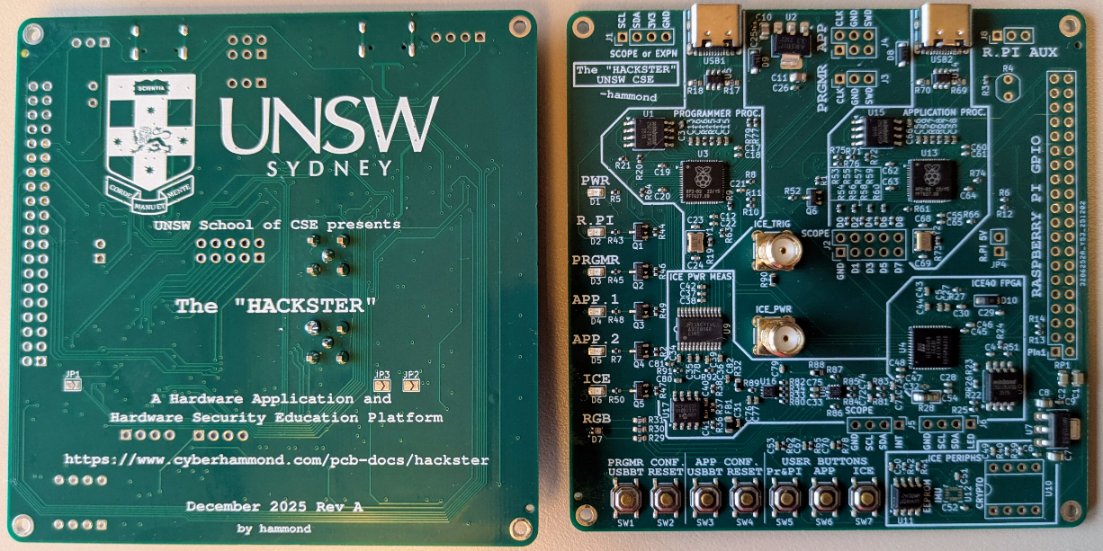
The Hackster Hardware Platform
Unlike the other FPGA-based courses at UNSW, COMP6420 is built around open-source tools (OSS-CAD-Suite / Yosys), and the Hackster itself is also open-source (CC BY-SA 4.0 licensed). It allows students to perform a variety of hardware security experiments. As a result of the toolchain, the platform can be used on Windows, macOS, and Linux systems. In fact, in 2025 we had one enterprising student run the entire toolchain on his Android phone!
We provide every enrolled student with a Hackster board for the duration of the course to use in labs and assignments. If you are interested, you can also download the production files and build your own Hackster board, or, more conveniently, order one pre-assembled. Contact the course convenor for more details.
The Hackster features an ICE40 FPGA, an RP2040 “application” microcontroller running MicroPython, a high-speed ADC to measure the power consumption of the FPGA, EEPROM and an RTC peripheral, and a second RP2040 “programmer” microcontroller to manage the FPGA and power measurements. Our firmware and example projects are also open-source and available on GitHub.
Using the Hackster platform, we cover a wide range of topics in COMP6420. This includes:
- the security consequences of design-for-test (i.e. susceptibility to scan attacks),
- the implementation of cryptographic algorithms and resulting side-channel weaknesses (i.e. simple, differential, and correlation power analysis; fault attacks),
- fault injection attacks,
- machine-in-the-middle attacks,
- hardware trojans,
- and more.
Feel free to explore the syllabus to get an overview of the course structure, grading, and schedule.
Also, check out the lectures section for detailed lecture notes and materials for each week, and the labs section for the graded hands-on exercises using the Hackster platform. Finally, the reports section contains instructions for the written assignments.