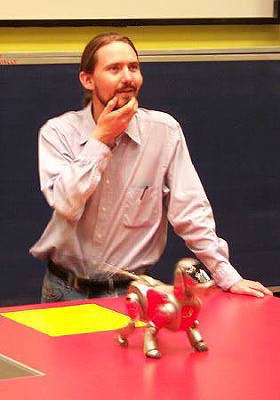
 I work as a program leader within the
ARC Centre of Excellence for
Autonomous Systems, where I am participating in a number of projects
including feature-based SLAM for underwater robots,
reinforcment learning for flying and walking robots,
and applications of information geometry to decentralized data fusion
for robot navigation and planning.
I have also had some involvement with the F180 League and the
Sony Legged League of Robocup, as well as
Robocup Junior.
I work as a program leader within the
ARC Centre of Excellence for
Autonomous Systems, where I am participating in a number of projects
including feature-based SLAM for underwater robots,
reinforcment learning for flying and walking robots,
and applications of information geometry to decentralized data fusion
for robot navigation and planning.
I have also had some involvement with the F180 League and the
Sony Legged League of Robocup, as well as
Robocup Junior.
[2] A.D. Blair & J. Ingram, 2003. Learning to predict the phonological structure of English loanwords in Japanese, Applied Intelligence 19, 101-108.
[3] M. Boden & A.D. Blair, 2003. Learning the dynamics of embedded clauses, Applied Intelligence 19, 51-63.
[4] J.B. Pollack & A.D. Blair, 1998. Co-evolution in the successful learning of Backgammon strategy, Machine Learning 32, 225-240.
[5] A.D. Blair & J.B. Pollack, 1997. What makes a good co-evolutionary learning environment? Australian Journal of Intelligent Information Processing Systems 4, 1997, 166-175.
[6] A.D. Blair & J.B. Pollack, 1997. Analysis of dynamical recognizers, Neural Computation 9(5), 1997, 1127-1142.
[7] A.D. Blair, 1995. Adelic path space integrals, Reviews in Mathematical Physics 7(1), 1995, 21-49.
Book Chapters
[8]
J. Wiles, A.D. Blair & M. Bodén, 2001.
Representation Beyond Finite States: Alternatives to Push-Down Automata,
in J.F. Kolen & S.C. Kremer (Eds.)
A Field Guide to Dynamical Recurrent Networks, IEEE Press, 129-142.
[9] E. Sklar, A.D. Blair & J.B. Pollack, 2001. Training intelligent agents using human data collected on the Internet, in J.Liu, N. Zhong, Y. Tang & P. Wang (Eds.) Agent Engineering, World Scientific, 201-226.
Conference Proceedings - Coevolution, Learning and Robotics
[10]
J. Thomas, A. Blair & N. Barnes, 2003.
Towards an efficient optimal trajectory planner for multiple mobile robots,
Proceedings of the 2003 International Conference on Intelligent Robots and Systems,
2291-2296.
[11] T. Ord & A. Blair, 2002. Exploitation and peacekeeping: introducing more sophisticated interactions to the Iterated Prisoner's Dilemma, Proceedings of the 2002 Congress on Evolutionary Computation, 1606--1611.
[12] S. Versteeg & A. Blair, 2001. Getting the job done in a hostile environment, Proceedings of the 14th Australian Joint Conference on Artificial Intelligence (LNAI 2256).
[13] D. Shaw, N. Barnes & A. Blair, 2001. Creating Characters for Dynamic Stories in Interactive Games, Proceedings of the International Conference on Application Development of Computer Games in the 21st Century.
[14] J. Wiles, H. Chenery, J. Hallinan, A. Blair, A. & D. Naumann, 2000. Effects of damage to the CDM Stroop model, Cognitive Science in Australia 2000: Proceedings of the Fifth Biennial Conference of the Australasian Cognitive Science Society.
[15] E. Sklar, A.D. Blair, P. Funes & J.B. Pollack, 1999. Training intelligent agents using human Internet data, Proceedings of the First Asia-Pacific Conference on Intelligent Agent Technology, World Scientific, 354-363.
[16] A.D. Blair & E. Sklar, 1999. Exploring evolutionary learning in a simulated hockey environment, Congress on Evolutionary Computation, 197-203.
[17] N.Ireland & A.D. Blair, 1999. Target signal selection for a neural network based financial classifier, ICSC Symposium on Soft Computing in Financial Markets.
[18] A.D. Blair, E. Sklar & P. Funes, 1999. Co-evolution, determinism and robustness, X. Yao et al. (Eds.): Proceedings of the Second Asia-Pacific Conference on Simulated Evolution And Learning (SEAL'98) LNCS 1585, 389-396.
[19] A.D. Blair & E. Sklar, 1998. The evolution of subtle manoeuvres in simulated hockey, Proceedings of the Fifth Conference on Simulation of Adaptive Behavior, Zurich, 1998, 280-285.
[20] E. Sklar, A.D. Blair & J.B. Pollack, 1998. Co-evolutionary learning: machines and humans schooling together, in: G. Ayala, ed., Proceedings of Workshop on Current Trends and Applications of Artificial Intelligence in Education, ITESM, Mexico, 98-105.
[21] A.D. Blair, 1999. Co-evolutionary learning - lessons for human education? Proceedings of the Fourth Conference of the Australasian Cognitive Science Society, Newcastle, Australia, 1997.
[22] J.B. Pollack & A.D. Blair, 1997. Why did TD-Gammon work? Advances in Neural Information Processing Systems 9, 1997, 10-16.
[23]
J.B. Pollack, A.D. Blair & M. Land, 1997.
Coevolution of a Backgammon player,
Proceedings of the Fifth International
Conference on Artificial Life,
MIT Press, 1997, 92-98.
Conference Proceedings - Dynamic Language Processing
[24]
B. Tonkes, A.D. Blair & J. Wiles, 2000.
Evolving learnable languages,
In S.A. Solla, T.K. Leen & K.-R. Muller (Eds),
Advances in Neural Information Processing Systems 12,
MIT Press, 66 - 72.
[25] S. Chalup & A.D. Blair, 1999. Hill climbing in recurrent neural networks for learning the anbncn language, Proceedings of the Sixth International Conference on Neural Information Processing, 508-513.
[26] M. Bodén, J. Wiles, B. Tonkes & A.D. Blair, 1999. Learning to predict a context-free language: Analysis of dynamics in recurrent hidden units, Proceedings of ICANN'99, Edinburgh, 359-364.
[27] B. Tonkes, A.D. Blair & J. Wiles, 1999. A paradox of neural encoders and decoders or Why don't we talk backwards? X. Yao et al. (Eds.): Proceedings of the Second Asia-Pacific Conference on Simulated Evolution And Learning (SEAL'98) LNCS 1585, 357-364.
[28] A.D. Blair & J. Ingram, 1998. Loanword formation: a neural network approach, Proceedings of the Fourth Meeting of the ACL Special Interest Group in Computational Phonology, Montreal, 1998, 45-54.
[29] B. Tonkes, A.D. Blair & J. Wiles, 1998. Inductive bias in context-free language learning, Proceedings of the Ninth Australian Conference on Neural Networks, Brisbane, Australia.
[30] A.D. Blair & J.B. Pollack, 1998. Quasi-orthogonal maps for dynamic language recognition, Proceedings of the Fourth International Conference on Neural Information Processing, Springer, 1997, 1065-1067.
[31]
A.D. Blair, 1995.
Two layer digital RAAM,
Proceedings of the Seventeenth Annual
Conference of the Cognitive Science Society,
Pittsburgh, PA, 1995, 478-481.
[32]
S.K. Chalup & A.D. Blair, 2000.
First Order Recurrent Neural Networks Learn to Predict a Mildly Context-Sensitive Language,
Department of Computer Science and Software Engineering,
The University of Newcastle, Technical Report 2000-06, ISBN 0-7259-1109-3.
[33]
A.D. Blair, 1997.
Scaling up RAAMs,
Brandeis University Computer Science Technical Report CS-97-192.
[34]
A.D. Blair, 1994.
Path Integrals on Ultrametric Spaces,
Doctoral Dissertation, MIT, 1994.
Technical Reports and Thesis
Return to Alan Blair's home page